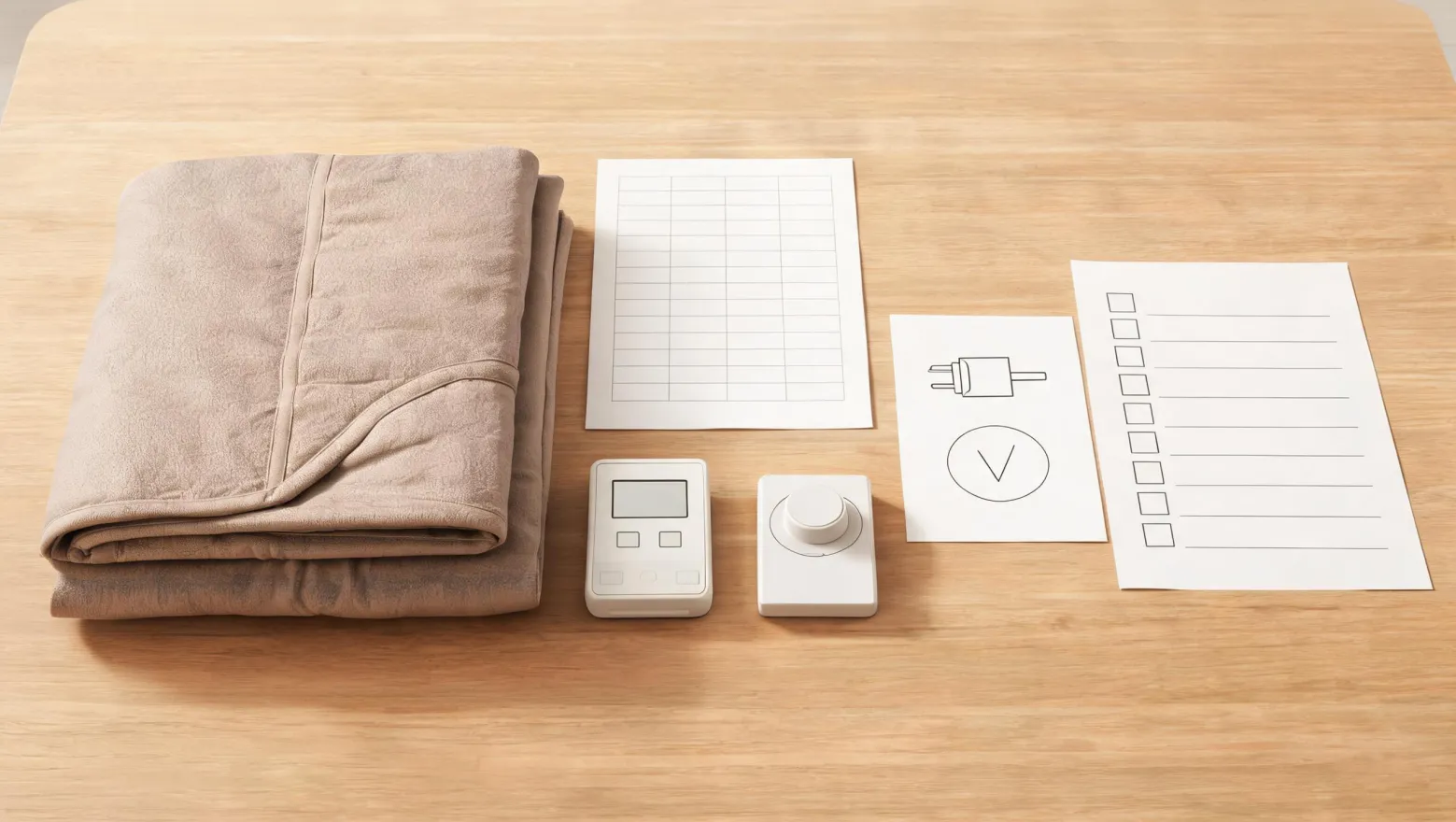
The mistake I run into most with this purchase is treating unboxing as setup. Someone unrolls the BON CHARGE Infrared Sauna Blanket across a made bed and climbs in without checking the manufacturer's instructions. The two conditions that shape a first session can be skimmed past in under a minute. When I read the saved manual pages, I noticed that flat placement and a clothing or towel barrier are written as conditions of use, not as comfort preferences. Skip them and the first session runs on assumption.
This checklist covers the BON CHARGE Infrared Sauna Blanket and nothing else. The saved manual supports three setup points for this model: far-infrared light is what raises the temperature and creates the heat; the blanket goes on a bed or other flat area and is not to be used wrinkled; and it is to be used only with clothes on and/or a towel or towel insert. Anything past those three, whether settings, session length, power supply or outcomes, is a question for the manufacturer, not a line to fill in from memory.
Start With the Wrinkled-Blanket Mistake
Wrinkles are the failure I would flag first, because they are easy to miss in a dim bedroom and plain in the manual's wording. The instruction is blunt: place the blanket on a bed or other flat area, and do not use it in a wrinkled state. Suppose a buyer lays it over a duvet, tucks the edges under a pillow, and climbs in with the middle bunched into a ridge. Nothing on the blanket tells them the surface beneath them is wrong. The flat-area rule is the only check available at that moment, and it takes seconds to run.
What I checked was where the prohibition sits. It is attached to use, not storage, so folding the blanket away creased is not what the sentence addresses; using it creased is. That distinction changes how you stage setup, because the spread-out step becomes part of operation and earns its own check before clothing enters the picture.
Flat is a condition, not a preference. The manual does not explain what happens when the rule is broken, and I will not invent a mechanism for it. The practical reading is simpler than a risk estimate: if the blanket is not lying flat and unwrinkled, that setup step is not finished, and everything after it is built on an unfinished step.
What the Manual Actually Controls
The manual is a controls document, not a buying guide. It ties far-infrared light to heat generation, then sets two conditions for use: flat and unwrinkled, and a clothing or towel barrier. Those are the only setup controls I can trace to the saved pages. They do not describe a sequence of settings, and they do not support a clinical outcome.
What sits outside that ground matters at purchase time. The saved pages give no temperature sequence, no session length, no power specification and no independent testing result, and they make no clinical claim anyone could repeat. A checklist built on those four missing items would be a checklist someone manufactured. Everything here stays tied to the BON CHARGE Infrared Sauna Blanket, so none of it travels to another blanket, another brand, or a different regional power configuration.
Place It Flat Before Anything Else
Position comes first, before clothing, before anything you might assume about the session. Choose a bed or another flat area, lay the blanket out, and smooth it until no section is doubled over or ridged. The completion check is visual and immediate: the surface under you lies flat and unwrinkled end to end.
I found that this is the first physical condition the manual sets, which tells you how the rest of the sequence should be ordered. Nothing else on the list can be verified while the blanket is still bunched. What I did not add here is a surface material, a room measurement or a clearance figure, because the saved instructions supply none of those, and a number pulled from the air would be worse than a step left open on purpose.
Get this wrong and the failure is quiet. A wrinkle does not announce itself as a setup failure; the check is visual, so a skipped condition can survive to the end of the session without being noticed. That is the part I care about as someone used to equipment in the field: mistakes that announce themselves get fixed, and mistakes that run silently get repeated.
Add the Clothing or Towel Barrier
The second condition is a barrier, written the same way as the first: the blanket should only be used with clothes on and/or with a towel or towel insert. Read that as an operating requirement rather than a comfort option, because the pages offer no alternative path for bare skin.
The completion check is short. Before you get in, either you are wearing clothes, or a towel or towel insert sits between you and the blanket surface, or both. If you cannot point to the barrier, the step is not done.
Stage it early. Fold the towel where you will lie rather than leaving it across the room; retrieving it after you are settled means climbing out and starting over.
Walk the Purchase-to-Setup Sequence
Here is the order I would run, from order confirmation to first session. First, match what arrived to what the instructions describe: the product name on the unit and the manual revision should both point to the BON CHARGE Infrared Sauna Blanket, not to a lookalike listing or an older sheet still in a drawer. A revision mismatch makes every later step uncertain, so it goes first.
Second, read the placement rule before you decide where the blanket lives. If your home has no flat area you are willing to use, that is a purchase-stage discovery rather than a session-stage surprise. Third, lay it out and run the wrinkle check described above. Fourth, stage the clothing or towel barrier so it is ready before anyone gets in.
Fifth, write down every model-specific detail the pages do not answer: power supply, temperature setting, session length, cleaning. Those become questions for the manufacturer. Suppose you bought through a reseller with a photocopied insert; in that case the revision check jumps to the front, because the whole sequence assumes you are reading instructions for the unit in the box.
The sequence has one property worth naming. Each step can be confirmed or failed before the next one starts. Either the unit matches the instructions or it does not. Either the blanket is flat or it is not. Either a barrier is staged or it is not. Nothing on that list depends on how the session feels afterward.
What the Manual Does Not Confirm
The saved material contains no independent clinical or use-test report for this blanket, no temperature, time or power sequence, and no parameter table for the model. That absence is the edge of the checklist, not an invitation to estimate around it.
My preference is to leave those gaps open. I would rather hand a buyer four unanswered questions than fill a temperature and a timer into a checklist so the page looks finished, because a filled-in number is the one thing here you could act on and be wrong about. Once the manufacturer answers with model-specific figures, those answers replace the questions and nothing else changes.
The questions worth sending are specific. Does this manual revision match the unit shipped to you? What power supply does this model require? Where are the temperature and timer instructions kept? And how does the manufacturer define a flat, unwrinkled setup if your only flat surface is a mattress with a topper on it?
The objection I expect is that a short excerpt cannot settle setup, and that is half right. It settles three points and no more: the heat comes from far-infrared light, the blanket lies flat and unwrinkled, and a clothing or towel barrier is in place. Stretch those into temperature, timing, power or any health claim and the checklist stops being documentation and becomes guesswork.
So confirm the two physical conditions today, on the bed you actually plan to use. Send the rest to the manufacturer before the first session rather than after it. That is the whole checklist: three confirmed points, two of them physical, and a short list of questions that stays open until the manual for your unit answers them.
Leave a purchasing question
Comments do not submit an RFQ. Use the requirements form for sourcing coordination.