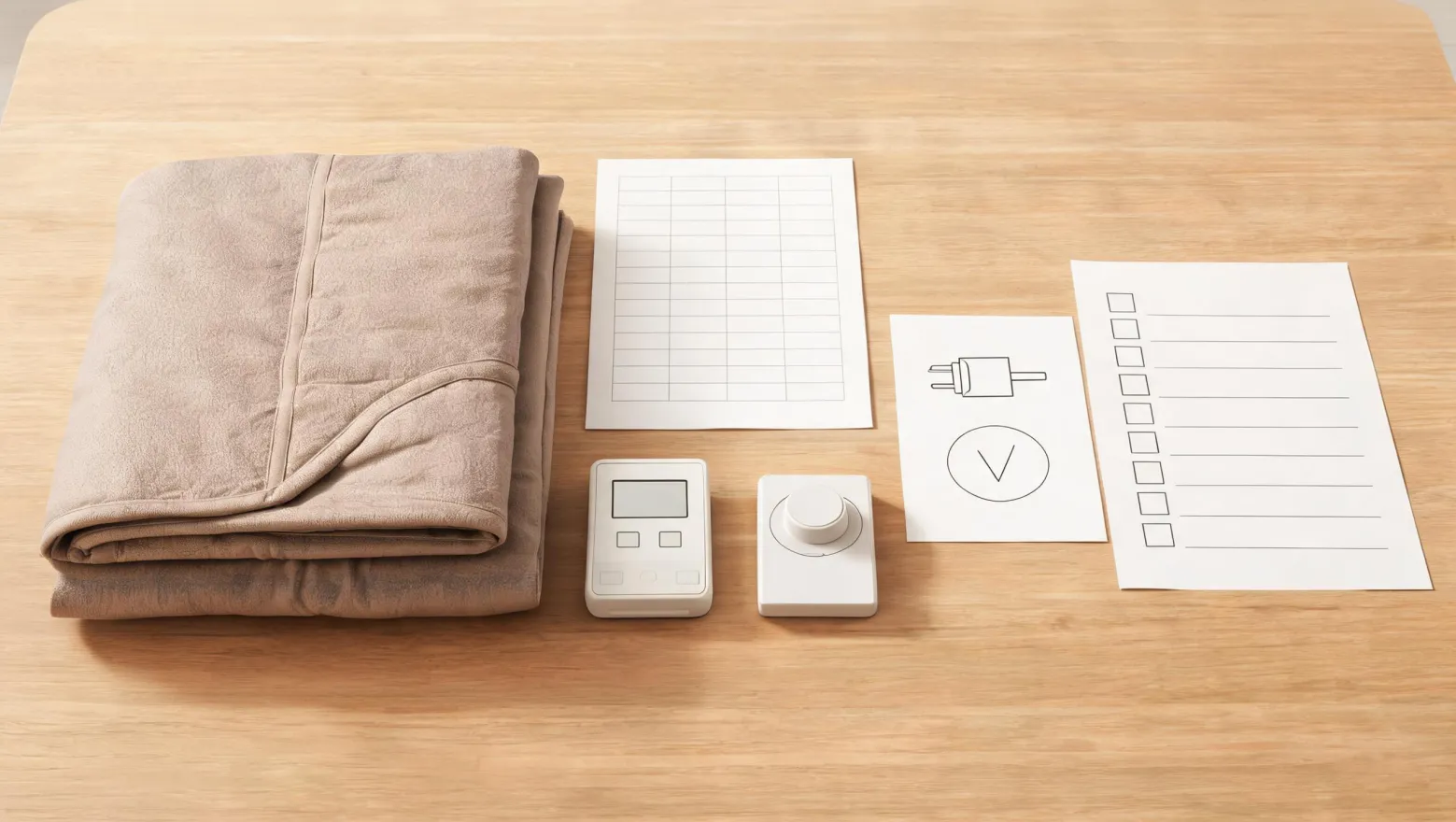
The BON CHARGE Infrared Sauna Blanket manual puts memory foam on its do-not-use list — the same mattress most buyers plan to unroll it on. That single line rearranges the whole setup, and it matters more than any heat setting you will pick.
Everything below stays scoped to the BON CHARGE Infrared Sauna Blanket and what its own user manual says about placement: where the controller goes, which surfaces are ruled out, and what would move you off that ruling. No therapy claims and no temperature advice — just the setup decisions the document actually makes.
The Controller Never Rests on the Blanket
The controller carries three instructions in a row, and all three are mandatory. It may be hot when in use. It must not be placed on top of the sauna blanket. It has to stay on a heat-resistant surface. Read those as separate facts rather than one warning: the controller is treated as something that gets hot on its own, so its resting spot belongs to the setup, not to the moment after the blanket is already warm. And the blanket's own fabric is explicitly not that spot.
What matches the wording: a nightstand, a side table, or a hard board beside the blanket — a surface you would describe as heat-resistant and that is not the blanket. What does not match: a folded towel, a pillow, or the fabric itself, because nothing in the document calls those heat-resistant. If the only clear surface in your room is the mattress, treat that as a cue to change rooms rather than improvise.
Memory Foam Beds Are on the Do-Not-Use List
The exclusion list reads: waterbed, bunk bed, latex or memory foam bed, mechanically adjustable bed, or a child's crib. Memory foam is named outright, not implied. You can read the list as grouping surfaces that either give under weight or move on their own, but that grouping is my reading, not something the manual spells out. The practical effect holds either way: "but it lies flat" does not rescue the setup, because flatness and surface type are two separate requirements and you have to pass both.
So here is the blunt version: if the tag on your mattress says memory foam, do not run this blanket on that bed. The manual grants no exception for memory foam as a bed surface. The thing that changes the answer is the surface itself — move the same blanket to a flat, firm area like a hard floor and this particular ban stops applying to you. Same product, different room, different verdict.
What Flat and Unwrinkled Actually Requires
A third line controls the other half of the setup: place the blanket on a bed or other flat area, and never use it in a wrinkled state. Two different things are being controlled there. One is a property of whatever sits under the blanket; the other is the condition of the blanket itself. A firm, level surface with the blanket smoothed out satisfies both readings. The wrinkle rule points at the blanket, not the bed, which is why a perfectly flat mattress does not get you out of it.
"A bed or other flat area" is broad wording, and I would not read it as permission for any bed you happen to own. It sits in the same document as the exclusion list, and the specific list wins over the general phrase. Read the two together and you get a narrow, workable answer.
A Placement Test You Can Run at Home
Suppose you want to check your own room instead of guessing from the manual. The hypothesis is narrow: a setup passes only if the surface stays flat under your body weight and the controller sits off the blanket on something heat-resistant. The method is a dry run you do before the first session, not during it.
Lay the blanket on the candidate surface and smooth it out. Get on it, stay put for a moment, get up, and look at the fabric where your hips and shoulders were. If ridges reform or the surface dips into a hollow, that surface fails the flat half. Then put the controller on your chosen side table and confirm no part of it rests on the fabric.
A pass looks like this: no ridge returns after you get up, and the controller is parked off the blanket on a heat-resistant spot. If it were my room, I would run the flatness half first, because that half decides where the blanket lives. The result is a fit check for your space, not a performance measurement — I have no independent test report for this blanket to point you at, so sort your own setup with it rather than grading the product.
First Night Setup Steps in Order
On the first night, three decisions should be settled before anything is switched on, and they go in order. Choose the surface first, because that choice can send you into another room. Smooth the blanket second, once it is on the final surface — smoothing it on the bed and then dragging it to the floor undoes the work.
Park the controller third, on the heat-resistant spot beside you, and confirm it is not touching the fabric. That order exists because each step constrains the next, and a controller placed first tends to end up on the blanket out of convenience. This is a walkthrough for your own room, not a record of a session run for this article.
What Still Looks Flat One Week In
The first week is when the setup drifts. Getting on and off the blanket a few times is enough to pull it slightly off center, and the controller tends to migrate toward the nearest flat thing, which is usually the blanket itself. Two checks cover it: does the blanket still lie unwrinkled on the chosen surface, and is the controller still off the fabric on a heat-resistant spot.
By the end of the first month, run the same two checks once more and add one question: has anything in the room changed? A new topper, a new mattress, a moved nightstand all reset the answer. Nothing here is a claim about how the blanket wears over time — it is a schedule for re-checking the two things the manual actually controls.
What Would Change This Verdict
The conclusion is tied to a surface, so anyone whose bed is not on that list is outside the ban entirely. Over-applying it to beds it never named is the more common error — a firm platform-bed reader is not the target of a memory foam line.
One thing I will not settle: whether a topper laid over a memory foam mattress changes anything. The manual does not describe that arrangement, so it stays an open question for the manufacturer rather than a workaround you can assume is fine. The wider claim here would also be overturned by a model-specific manual page or a manufacturer statement that differs from the version this is based on, or by a different model or regional power configuration, where none of these lines can be assumed to carry over.
One action today: read the tag on your mattress. If it says memory foam, move the whole session to a flat floor area and set the controller on a heat-resistant table beside you. If it does not, lift the controller off the blanket before your first session anyway, and read the placement page of your own model's manual. It takes a moment and it settles the setup before you ever lie down.
Leave a purchasing question
Comments do not submit an RFQ. Use the requirements form for sourcing coordination.