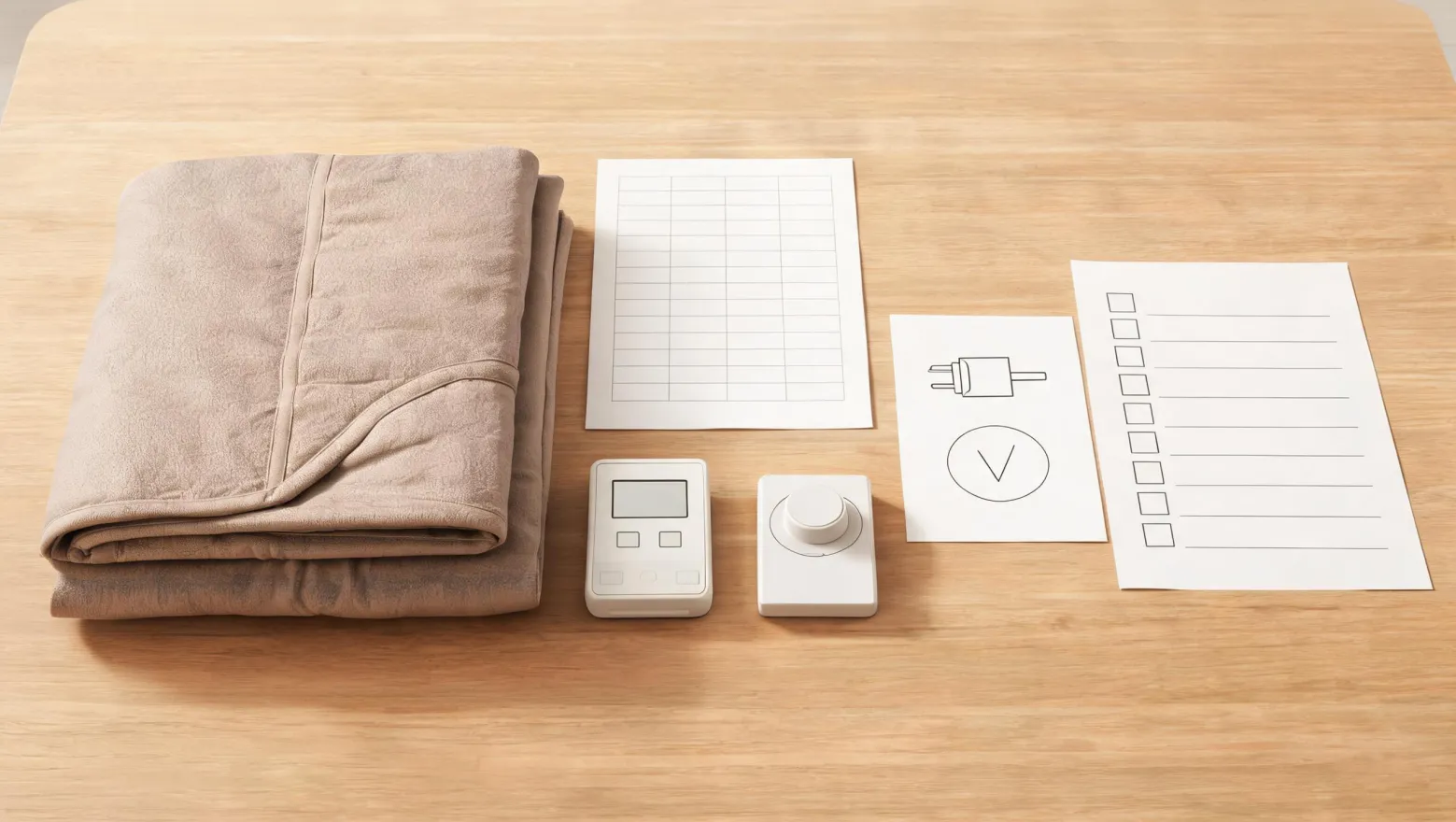
Can you clean a BON CHARGE Infrared Sauna Blanket while it is still warm? No. The user manual for this blanket says to let it cool completely before you clean or store it, and that one line determines how the rest of the routine is built. Every step that follows — blotting sweat, choosing a cleaner, putting the blanket away — assumes a surface that has already shed its heat.
Read it as a maintenance sequence with four gates: cooldown, dry blotting, a mild cleaner only where residue survives the blotting, and cool, dry storage. Run them in order and a session costs you a short wait. Treat them as optional and you end up redoing a step you skipped, which is the expensive version. The scope here is the BON CHARGE Infrared Sauna Blanket and the instructions written for it, not sauna blankets in general.
Cool-Down Is a Gate, Not a Guideline
The condition that has to be met before any other step starts is straightforward: the blanket must be completely cooled down before cleaning or storing. That is a gate, and it is the one step you can't fast-forward — a blanket that came off a session ten minutes ago is not ready for a towel, a wipe, or a shelf. The captured instructions do not give a cooldown time, which is why the gate is written as a condition to meet rather than a countdown to run.
Holding that line is mechanical rather than ceremonial. A warm surface typically keeps sweat liquid longer and holds moisture in the layers under it, so a towel pass on a hot blanket tells you very little about whether the surface is actually dry. Do the blotting after a full cooldown and the towel gives you a readable answer, which is the input every later decision needs.
Scheduling is where this gate usually fails. Suppose the session ends at ten at night and you want the room back; that is exactly the moment the wait starts to feel optional. Two workable versions exist: leave the blanket open and finish the job before the next use, or move the cleanup to the morning. What does not work is compressing the cooldown into a few minutes of optimism and starting to wipe. If two people use the blanket back to back, the gate has to clear twice before either cleanup begins.
If you are still deciding whether to buy, the cooldown window is the honest way to judge fit. A blanket that needs an unattended cooling period does not suit a schedule where the equipment has to be packed away within minutes of use. Go with it if the blanket can stay out; skip it if your routine has no room for a wait that cannot be shortened.
Blot Sweat Before It Becomes a Cleaning Job
The first physical action after cooldown is dry, not wet: use a soft cloth or towel to absorb sweat. Blotting is a separate control because it removes the moisture load, while the cleaner step that may follow exists for residue. Keeping the two apart has a practical payoff — a light session ends at the towel, and only a session that leaves visible residue escalates to a cleaner.
If the surface is only sweaty, go with dry blotting and stop there. If blotting leaves a film, a mark, or a tacky patch that the towel does not lift, then move to the gentle cleaner class the manual supports. The trade-off is one evaluation step before you reach for anything wet, and in exchange you avoid turning every session into a wet-cleaning event.
That towel pass is also the step that decides which of those two paths you take, so it deserves real attention rather than a quick swipe over the middle of the surface. Keep a dedicated soft cloth with the blanket so the decision does not depend on finding something absorbent at the moment you need it; that single piece of supply planning keeps the sequence from stalling at gate two. Imagine a session that ends with a dry surface and no visible residue: that night the work is a towel and then storage, with nothing to wash and nothing to soak.
Switch to a Gentle Cleaner and Skip Alcohol
On cleaners, the manual is narrow: a non-toxic cleaner such as gentle soap, or a non-toxic cleaning wipe. It also names two things not to use — a strong corrosive cleaner and alcohol. Adopt that substitution now: pull the alcohol wipes out of the kit and replace them with a labeled gentle soap or a non-toxic wipe. The effect is that whatever you reach for stays inside the supported class, and you stop adding an aggressive chemistry step to a routine whose value depends on being repeatable.
The cost is real and you should feel it: gentler chemistry means less cleaning strength, so you are trading speed for a narrower, manual-compatible choice. If a mark does not lift with gentle soap, that is a signal to stop and re-read the instructions for your model, not a signal to escalate to a stronger product the manual has already ruled out.
Treat non-toxic as a filter on the label rather than a guarantee, because a product sold as natural can still be harsh; the restriction is about what the chemistry does to this blanket, not about how it sounds in marketing copy. A buyer who reads labels before the first session never has to guess at gate three.
The Washer Is Not a Shortcut
Three methods are ruled out in plain language: do not submerge the blanket in water, do not place it in a washing machine, and do not dry clean it. Those three cover the entire laundry reflex — soak, cycle, drop-off — which is why the boundary is worth stating before you are standing over a hamper with a damp blanket in your hands.
The trap here is category confusion. A sauna blanket looks like a textile and folds like one, so the habit fires before the thought does. If your hand is already moving toward the machine, skip it; the trade-off is slower, surface-only work in place of a deep-clean shortcut the manual does not offer.
What the manual does not provide is an approved deep-clean procedure, and that absence matters. There is no captured instruction describing a soak, a machine cycle, or a solvent drop-off, so improvising one from household laundry practice means inventing a method for a heated electrical product that no instruction covers. If a mark survives the gentle cleaner, that is a question for the manufacturer rather than a cue to improvise; asking is cheaper than guessing.
Store It Cool and Dry or Lose the Next Session
Storage is the last control in the same sequence, not an afterthought: keep the blanket in a cool, dry place, and only after the cooldown is complete. The two instructions sit in the same passage for a reason — one closes out the cleaning step, the other sets the condition the blanket waits in until the next session.
A blanket put away warm carries that heat into wherever it lives, and a damp storage spot gives moisture nowhere to go. If your only options are a humid bathroom or a hot garage, treat that as a placement problem to solve before the first session rather than a detail to sort out later, because the storage condition is part of normal use, not a special case. The captured instructions give no temperature or humidity figure for cool and dry, so treat it as a comparison between the spots your home offers rather than a target to measure.
If the blanket is still warm when you are ready to put it away, or you cannot give it a cool, dry spot, wait. What you give up is a delayed put-away — the blanket stays out longer than you would like — against undoing a storage step you did out of order and running the tail of the routine again.
Make the Call at the End of a Session
Here is how the four controls collapse into one decision when a session ends and you are standing there with limited time and a warm blanket. Each branch is decided by what the surface tells you and how much of the cooldown window you can actually give it.
If the blanket is still warm, wait and start with cooldown; nothing else is available yet, and no amount of wiping changes that. If it is cool and only sweaty, go with dry blotting and skip the cleaner entirely. If blotting leaves residue, move to a gentle soap or a non-toxic wipe and skip alcohol and corrosive cleaners, accepting the weaker cleaning strength as the price of staying inside the supported class.
If you want a fast alcohol wipe because the session ran long, skip it. Alcohol is named as prohibited, and speed is not a reason to override a cleaner restriction on a heated product. If you are tempted to wash the blanket like fabric, skip submersion, machine washing, and dry cleaning together, and accept slower spot work as the trade-off. If the only spot available at the end of the night is warm or damp, defer storage rather than putting the blanket away there.
Any household using the blanket on a nightly schedule can place the cooldown where it overlaps with something else — dinner, a shower, the walk back from the gym — so the wait stops competing with the rest of the evening. That brings the answer back to the question at the top: can you clean it while it is still warm? No, and the answer does not loosen because the evening ran late. If tonight cannot give the blanket a full cooldown and a cool, dry place, defer the cleanup to the morning; the routine only works in order, and starting it late is worse than starting it tomorrow.
Leave a purchasing question
Comments do not submit an RFQ. Use the requirements form for sourcing coordination.